We Ran the Numbers. Property Due Diligence Barely Uses AI Yet.
August 2026 · SeaGoat
Anthropic publishes an open dataset that measures how usage of its AI assistant breaks down across the working world, mapped to the U.S. Department of Labor's occupation catalog. We pulled the latest release and tabulated the May 2026 window ourselves: 718 professions, ranked by share of global usage.
Here is where property work landed. Real estate appraisers and assessors came in at 0.04% of global usage. Construction managers and property managers sat at 0.01% each, and construction and building inspectors rounded to 0.00%. Computer and mathematical roles, for comparison, accounted for 23.8%.
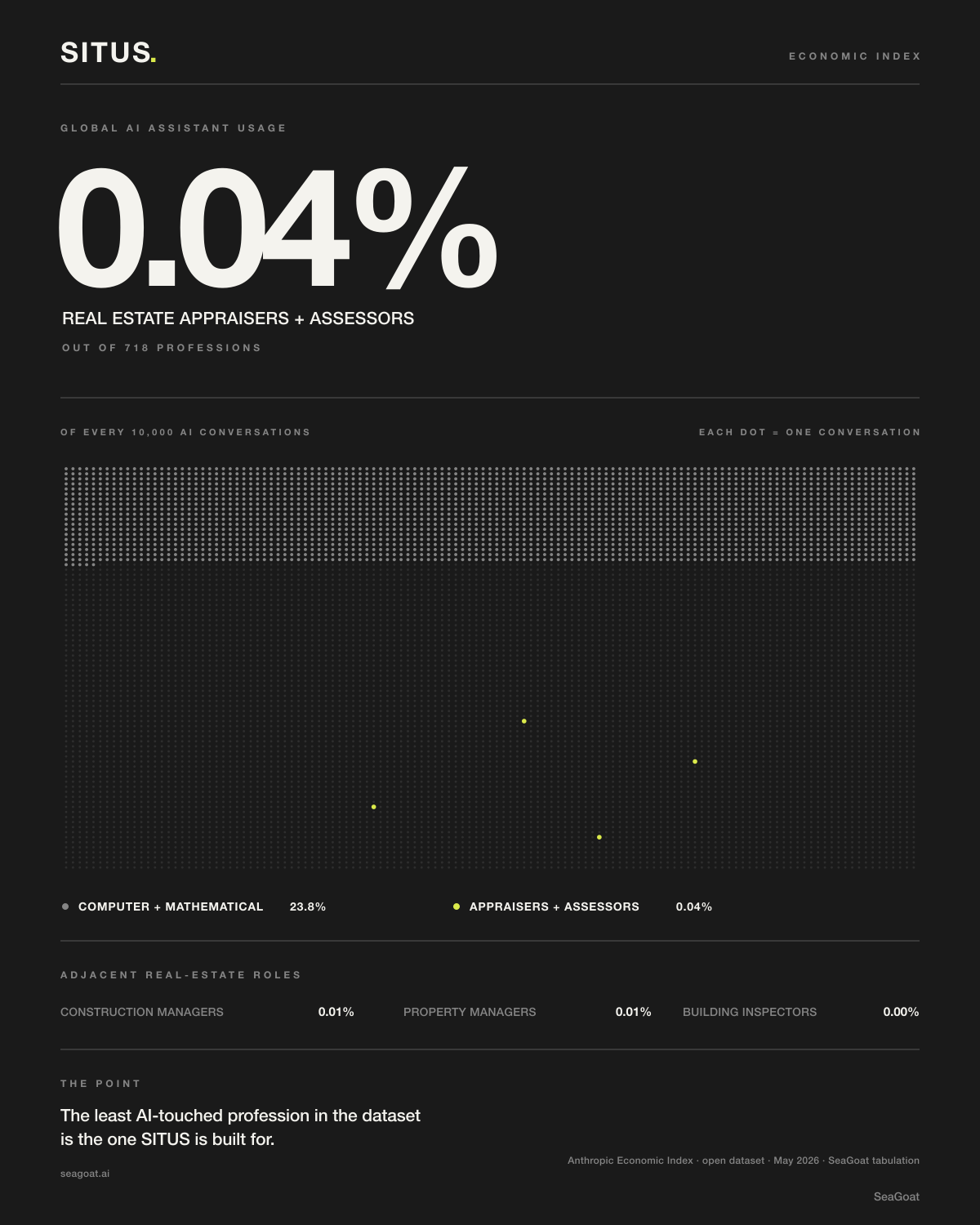
Property due diligence sits at the very bottom of the board. The obvious explanation would be that the work does not fit AI. The obvious explanation is wrong. Assessment work is photographs, checklists, condition calls, cost tables, and public-record research. Reading images, drafting structured text, and pulling government data are among the things this technology already does well.
The real explanation is that the profession has a requirement most AI tools were never built to meet. Every finding in an assessment ends up under a professional's signature. A chat window that produces a confident paragraph with no chain back to the evidence is not a time-saver in this field. It is a liability generator. Assessors are not behind on AI. They are correctly refusing tools that cannot survive the question a lender, a buyer, or a courtroom will eventually ask: how do you know that?
That is the standard we build SITUS to. Every AI-drafted finding is bound to a checklist item and tied to the photograph it came from. Condition and cost proposals arrive in ASTM E2018 phrasing with their basis attached. Validation blocks an incomplete report from shipping. The reviewer confirms or overrides every call, every override is logged, and nothing reaches the report until a person approves it. The AI clears the gathering and the first pass. The professional keeps the signature, and the evidence chain proves the reasoning behind it.
This is why we think the debate about what AI should do in technical work misses the point when it stops at speed, and equally when it stops at searching what a firm wrote in the past. Precedent tells you how to phrase a finding. Evidence is what makes it true. The axis that decides adoption in a liability profession is neither speed nor recall. It is whether the AI's contribution to the report you are signing today is traceable, reviewable, and defensible the day someone challenges it. Speed is a consequence of getting that right. So is trust.
A profession at 0.04% is not a profession AI forgot. It is a profession still waiting for tools built to its standard. The firms that adopt on that standard first will compound the advantage for years while the rest of the industry waits for someone else to prove it out.
We make living intelligence.
Source: Anthropic Economic Index, open dataset, May 2026 window. Figures are our own tabulation of global usage share by occupation from the public release at anthropic.com/economic-index.